
Guidelines
-
Place the anchors high and in line-of-sight of the tags.
Placing the anchor high (on the ceiling or on the walls) increases the chance of receiving a good signal because there are less obstructions. Obstructions generally have a negative influence on the accuracy of the range measurements which has a direct effect on the positioning accuracy. -
Spread the anchors around the tags. Don't place them on a straight line.
The accuracy of a TDOA system depends on receiving signals from multiple different angles. When anchors are arranged in a straight line, the system suffers from poor geometric resolution, which significantly amplifies signal noise and causes large positioning errors.By spreading the anchors out, you provide the system with the diverse perspectives needed to calculate a precise coordinate.
The Convex Hull Principle
Reliable positioning occurs primarily within the "convex hull," which is the area enclosed by your outermost anchors. If a tag moves outside this boundary, all signals originate from a single direction; this lack of geometric diversity causes a rapid decline in accuracy and system stability.
-
Ensure each anchor has a line of sight to at least two (ideally more) neighbors at a distance of 15m to 40m, depending on environment and regulations.
It’s very important that the clocks of the anchor are accurately synchronised with each other1, and this happens through UWB. It’s therefor important that not only the tags have line-of-sight to the anchors, but also that the anchors have a line-of-sight with each other. -
Place anchors vertically, with the connectors at the top. This keeps the antenna at the bottom.
-
Materials like metal, water and wires should stay away from the anchors, especially the antenna.
Within a few centimeters from the antenna, there should be no metal at all, not even small screws (this holds for the tag antenna too). -
It is recommended to have a separation of 20 cm between the anchor and walls. Our mounting equipment can be used to achieve this.
For 3D positioning
Under ideal conditions, 3D positioning is achievable. Pozyx engineers can evaluate your specific use case to determine its feasibility. Note that 3D tracking is disabled by default in the software and must be manually activated by Pozyx engineers for your project.
-
Keep to the guidelines from above but place anchors at different heights.
The accuracy of the z coordinate will highly depend on the spread in heights of your anchors. Ideally, it is advised to place your anchors in the shape of a cube around your positioning zone as shown below. Try to maximize the distance between the lower and higher anchors. -
Twist the base surface of your cube 45 degrees as compared to the top surface.
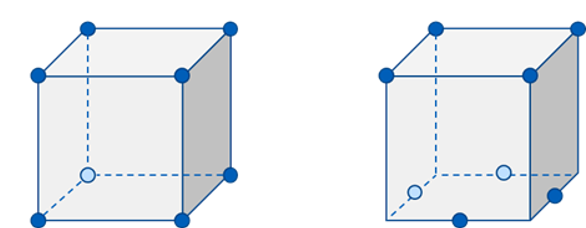
Twisting the base surface will reduce the 3D convex hull of the anchors (e.g. the bottom corners of the cube are outside of the convex hull), but it will generally give you a higher chance of line-of-sight between a tag and the anchors. E.g. when your body is blocking 1 corner of the room it will just block line-of-sight with 1 anchor instead of 2.
Furthermore its better for the tag to be surrounded by anchors from as much directions as possible. -
Place the bottom anchors upside down as this will point the antenna upwards (= towards the tags).